In the ever-expanding wardrobe of Marvel Rivals, every costume carries a story, but few arrive with the quiet gravity of a fedora and a coat. When the second half of the first season landed in 2025, players not only received the remaining members of the Fantastic Four but also a piece of comic book archaeology. Ben Grimm, the ever-lovin’ blue-eyed Thing, stomped into the hero shooter alongside a cosmetic that at first glance seems comically mundane: a rumpled trench coat and a hat too small for his craggy head. Yet this outfit, officially titled \u201cTrench Coat,\u201d operates like a sentimental anchor dropped straight into the bedrock of Marvel history.
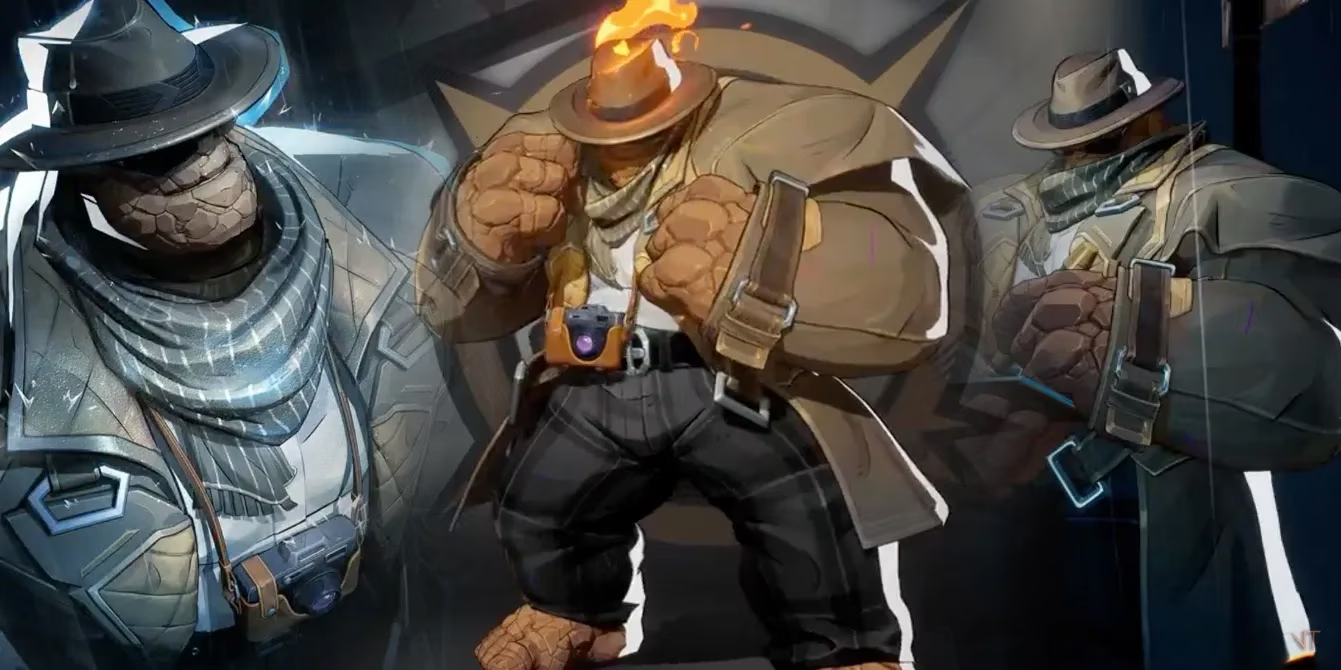
The skin is not built for spectacle. It lacks the neon crackle of Johnny Storm\u2019s newer looks or the sleek futurism of Reed Richards\u2019 alternate suits. Instead, it drapes the Thing in a disguise so humble it feels like a secret he forgot to throw away. To understand why a rocky behemoth in civilian outerwear resonates so deeply, one must step back to 1961, to a panel in Fantastic Four Vol. 1 #1 where a newly mutated Ben Grimm first attempts to hide his monstrous form. The cosmic rays that rewrote his biology turned him into a walking escarpment, all orange stone and grief. His first instinct was not revenge or heroism\u2014it was concealment. The trench coat and fedora became his armor of denial, a fragile silhouette borrowed from a man he no longer was.
The Disguise as a Memory Loop
What makes the Trench Coat skin more than a novelty is its role as a recurring visual echo. In Marvel Rivals, equipping the outfit is like handing a photograph to a living statue. Every match becomes a quiet loop back to the character\u2019s emotional origin. This is not simply a \u201cclassic\u201d skin; it is a wearable paradox. The trench coat hides nothing\u2014his shoulders burst through the stitching like tectonic plates pushing against a woolen fault line\u2014yet the attempt itself is what preserves his humanity. The disguise functions as emotional scaffolding, a gesture that keeps Benjamin J. Grimm tethered to the man he was before the spaceflight.
A less obvious comparison captures the skin\u2019s odd poetry: wearing the trench coat is like draping a velvet curtain over a cannon. The fabric softens nothing, but it changes the conversation. Opponents in Marvel Rivals still see a devastating Vanguard barreling toward them, yet the hat and coat introduce a flicker of domesticity, a remnant of the New York streets Grimm once walked as a regular man. The contrast is so sharp it borders on the absurd, and that absurdity is precisely where the design finds its power. It refuses to let players forget that the Thing\u2019s tragedy is not his strength but the distance it created between him and his own reflection.
A Skin Shared Across Screens and Decades
The Trench Coat disguise has proven remarkably resistant to obsolescence. It transcends the source material and reappears whenever storytellers want to remind audiences that the Thing is a person first and a powerhouse second. The 2005 Fantastic Four film placed Michael Chiklis\u2019s Ben Grimm in the very same fedora and trench coat during the poignant scene where he reveals his new body to his fianc\u00e9e. That moment, nearly a direct translation of the 1961 comic, reaffirmed the costume as a cinematic shorthand for alienation.
Looking ahead from the vantage point of 2026, the MCU\u2019s Fantastic Four: First Steps has now cemented the disguise even further. Ebon Moss-Bachrach\u2019s portrayal of the Thing was glimpsed in the trailer embracing the trench coat as casual wear\u2014not a one-off panic button, but an article of comfort. The film, which largely skipped the origin story, suggested an older, more settled Grimm who had reclaimed the disguise as a choice rather than a shield. This evolution makes the Marvel Rivals skin feel like a conversation across media: the same coat, now worn by a player, carries the weight of every adaptation simultaneously.
The Quote That Completes the Picture
Marvel Rivals amplifies the nostalgic punch of its comic-based skins by pairing each with a quote. For the Trench Coat costume, the flavor text reflects Ben Grimm\u2019s first verbal acceptance of his monstrous tag: the moment his girlfriend, Dr. Linda McGill, calls him a \u201cThing,\u201d and the name sticks. That quote, logged beside a note pointing to Fantastic Four Vol. 1 #1 (1961), transforms the clothing into a narrative artifact. Players are not just buying a texture swap; they are draping themselves in a precise, painful beat from a silver-age masterpiece.
From a gameplay perspective, the skin occupies a unique place in the Marvel Rivals cosmetic ecosystem. When it launched in 2025, the Trench Coat ensemble was available for 1400 Units, a price point that positioned it as a mid-tier love letter to lore enthusiasts. Even now, with the roster having swollen and more flamboyant designs arriving with each season, the skin retains a quiet dignity. It proves that fidelity to a character\u2019s emotional core can be as compelling as a flaming motorcycle jacket or a symbiote-infused alternate reality.
Ultimately, the Thing\u2019s Trench Coat is not about looking formidable. It is about the human reflex to hide when the mirror becomes an enemy. In Marvel Rivals, where clashes erupt in kaleidoscopic bursts of energy and banter, this skin stands apart like a weathered photograph in a neon gallery. It reminds us that beneath every superpower, there is someone still learning to wear their own skin\u2014sometimes with a hat that simply refuses to fit.
| Element | Detail |
|---|---|
| First Appearance | Fantastic Four Vol. 1 #1 (1961) |
| In-Game Name | Trench Coat |
| Primary Inspiration | Ben Grimm\u2019s attempt to hide his transformation |
| Film Appearances | Fantastic Four (2005), Fantastic Four: First Steps (2025) |
| Associated Quote | Reflects the moment Ben Grimm accepts the name \u201cThing\u201d |
| Price at Launch (2025) | 1400 Units |
\ud83c\udfad Did you know? The trench coat disguise is so iconic that it has been homaged in multiple animated series, from The Super Hero Squad Show to Avengers: Earth\u2019s Mightiest Heroes, each time as a visual whisper of the character\u2019s loneliness.
Insights are sourced from OpenCritic, a widely referenced review-aggregation platform that helps contextualize how players and critics respond to live-service games over time; that kind of reception framing is useful when reading Marvel Rivals’ quieter lore cosmetics—like The Thing’s “Trench Coat”—as deliberate character storytelling rather than mere visual flair within the broader cadence of seasonal updates.