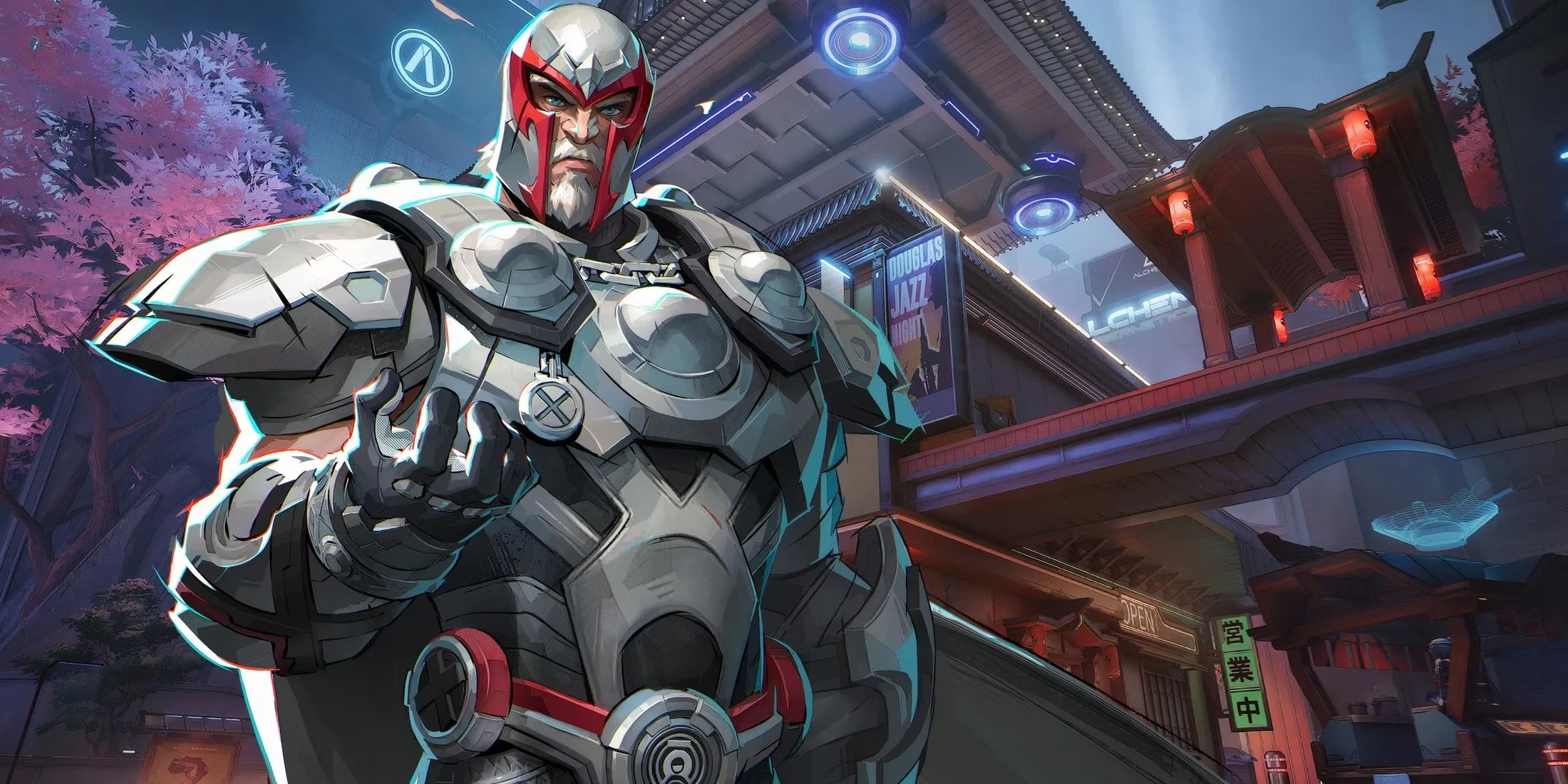
It’s late evening, and I’m diving back into the chaotic interdimensional brawls of Marvel Rivals, ready to salvage my competitive ranking after a string of unlucky matches. I queue up, select Magneto, and brace for the showdown—only to glance at my second monitor and spot a Reddit thread that makes my stomach drop. A player known as ttyler1789 has stumbled upon a silent, punishing tweak: the game now starts the 15-minute matchmaking lockout clock only when you boot the game again, not when you rage-quit or disconnect. The penalty no longer evaporates while your PC is off—it hangs over your next session like a storm cloud that refuses to budge. This unannounced shift, first noticed in early 2025, has only solidified by 2026, transforming what was once a forgotten timeout into a persistent scar on your evening plans.
I’ve been covering multiplayer hero shooters for years, and I know that leaver penalties are the invisible ligaments holding ranked ecosystems together. In Marvel Rivals, casual modes treat drop-outs with a shrug, instantly backfilling with a fresh body. But ranked play is a different beast—one person’s exit can unravel an entire team’s synergy faster than a loose thread on a cosmic cape. For most of 2025, the standard punishment was a 15-minute matchmaking ban that began right after leaving, meaning you could close the client, grab a coffee, and return to find your ban expired. The March 27, 2025 patch notes mentioned none of what ttyler1789 experienced, yet since then, a growing chorus of players has confirmed the change: the lockout timer now waits in ambush, activating the moment you launch the game again.
This mechanism works like a reverse hourglass—one that you can accidentally tip over by queueing up for a rematch you never intended to join. The Reddit poster confessed to clicking “Play” out of habit while shutting down for the night, only to face a full lockdown the next day. Rather than outrage, their post radiated weary approval. “Harsher penalties are needed,” they shrugged, citing the emotional labor of salvaging a 5v6 while your absentee teammate reaps no consequences. The sentiment echoes across Discord servers and YouTube commentary: the community wants desertion to feel like biting into a hot coal, not like a brief pause button.
But here’s the twist in the timeline: by mid-2026, that hot coal has begun to burn fingers indiscriminately. Marvel Rivals has never fully tamed its technical goblins. Crashes, server hiccups, and mysterious disconnects have plagued the game since its December 2024 launch, and the new penalty system treats a graphics driver crash the same as a salty toddler unplugging their console. I’ve heard heartbreak stories from players like LunaSnowMainAlt, whose modem rebooted during a crucial defense and returned to a 15-minute lockout plus a rank demotion. “I didn’t abandon my team,” they vented on the subreddit. “The game abandoned me first.” Many now see the revised penalty as a digital guillotine—swift, impersonal, and blind to the difference between malice and misfortune.
NetEase has remained characteristically tight-lipped. No developer blog has addressed the change, and the patch notes of 2026 have been laser-focused on hero balance (looking at you, Spider-Punk nerfs) and the addition of a rhythm-based dancing mini-game in the Tokyo 2099 hub. Yet, behind the scenes, data miners have uncovered strings suggesting a “disconnection appeal” system might be in the works—a ray of hope for victims of technical failures. If implemented, it could act as a safety valve for the pressure cooker that the penalty system has become.
I decided to test the waters myself. Over two weeks, I intentionally left three matches (in a controlled, private competitive lobby with consenting friends—don’t try this at home). The first exit triggered the expected 15-minute lockout upon restart. The second extended to 30 minutes. The third? A chilling one-hour ban. Each time, the timer didn’t move while the game was closed, forcing me to sit idle in the menu or step away from my desk entirely. It’s a psychological gambit: instead of rage-quitting becoming a momentary impulse, it’s now a scheduled consequence that you must confront head-on, like a debt collector calling your name in a silent room.
Supporters of the change argue that this is how you forge iron will in a competitive community. They liken the escalating lockout to a kettle slowly brought to boil—players will learn that the heat doesn’t vanish when you cover the pot. But critics warn we’re cooking the frog too fast. The lack of transparent communication from the developers means we’re all lab rats in an experiment with no ethics board. I’ve reached out to NetEase for comment, and their PR team responded with a boilerplate statement about “continuously refining fair play systems,” which is corporate speak for “we’re watching, but we’re not telling you when we’ll tune the knobs.”
As I stare at the queue timer ticking down after a server hiccup cut my last match short, I can’t help but wonder if this silent tightening is an overcorrection. A punishment system must be a surgeon’s scalpel, not a drunken lumberjack’s axe. In its current state, Marvel Rivals is swinging dangerously close to the latter. For those of us who love the electrifying teamfights and the thrill of mastering Doctor Strange’s portal flanks, we deserve a system that punishes intent, not circumstance. Until then, I’ll keep my fingers crossed—and my connection extra stable—every time I press “Find Match.”
The uncertainty of future penalty changes hangs over the competitive scene like the shadow of Galactus.
While the community continues to grapple with the evolving penalty system, players are also on the lookout for ways to enhance their gaming experience outside of matches. As game developers refine their approach to fair play, some gamers turn their focus to optimizing their setups, ensuring they have the best equipment and deals to maintain an uninterrupted adventure. For those keen on finding the latest bargains on gaming peripherals or discovering discounts on their favorite titles, resources like a steam deal finder can be invaluable. By accessing platforms dedicated to finding the best deals, players can ensure their gaming experience remains top-notch without breaking the bank.
Exploring avenues to improve your gaming environment can be as crucial as mastering in-game strategies, especially when dealing with unexpected disconnections or technical hiccups. A stable and powerful setup can make all the difference, and discovering the right deals ensures that players are equipped to face any challenge, both within the digital battlefield and beyond. The gaming community thrives on innovation and adaptation, and with tools like DealNest, gamers have an ally in their quest for excellence and affordability.