I have a confession: I’ve spent way too much time imagining a world where Spider-Man on PS5, Midnight Suns, and Marvel Rivals all share a single, sacred timeline. A world where every web-swing, punch card, and dimension-hopping squirrel girl syncs up like some beautifully obsessed film-bro’s corkboard. And boy, did Disney almost give me exactly that. But they didn’t. And now that I’m staring into the chaotic abyss of 2026’s current gaming landscape, I can’t help but feel like we all dodged a narrative vibranium shield.
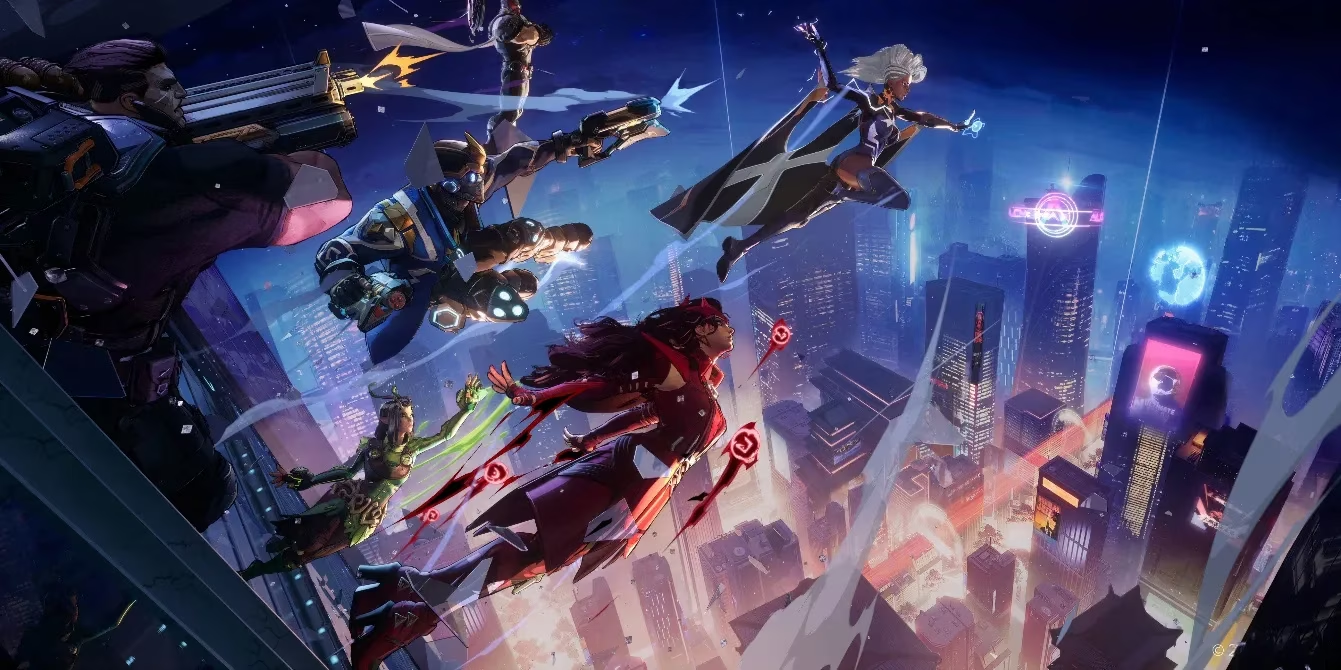
Here’s the tea, straight from the mouths of people who were in the room. On a recent episode of The Fourth Curtain podcast, Marvel Rivals writer Alex Irvine and former Disney games boss Alex Seropian let slip that once upon a time, a “Marvel Gaming Universe” was actually on the table. Not a loose collection of licensed titles, but a full-blown MGU—every game locked into the same chronology, nodding at each other like a bunch of overly polite Avengers. And I mean every game. We’re talking a timeline so strict it would make the Sacred Timeline look like a choose-your-own-adventure book.
“When I first started working on Marvel games, there was this idea that they were going to create like a Marvel gaming universe that was going to exist in the same way that the MCU,” Irvine revealed. And then Seropian drops the bomb: “When I was at Disney, that was my initiative, ‘Hey, let’s tie these games together.’ It was pre-MCU, but it didn’t get funded.” That’s right—pre-MCU. Imagine a parallel reality where the gaming universe launched before the movies ever got their interconnected act together. Iron Man wouldn’t even have had his first suit, but somehow Spider-Man on PS1 would need to set up a post-credits scene for X-Men Legends. My brain hurts just typing that.
The truth is, making a video game is already the equivalent of building a skyscraper while riding a unicycle. Tying multiple skyscrapers together with invisible narrative strings? That’s a recipe for the entire block to collapse into a pothole of retcons and developer tears. Irvine pretty much said as much: “Even back then, we were trying to figure out, ‘If there’s going to be this MGU, how is it different from the comics? How is it different from the movies? How are we going to decide if it stays consistent?’ And I think some of those questions got complex enough that there were people at Disney who didn’t really want to deal with them.”
Can you blame them? I mean, really. Picture this: Insomniac’s Spider-Man 2 hits in 2023 and the Venom symbiote acts all cozy with Harry, but then Marvel Rivals drops a year later and the symbiote is now prancing around with Eddie Brock again. The timeline guys at Disney would have to convene an emergency council, probably held in a dark basement lit only by the glow of a whiteboard so covered in red string it resembles Cthulhu’s knitting project. And that’s just one symbiote. Imagine keeping track of where Wolverine’s adamantium skeleton is at any given moment across ten different studios.
What I love most about this whole “what if” is the sheer hubris. The MCU itself is already buckling under continuity weight—watch any Phase 5 project and tell me you don’t need a PhD in Marvel lore to understand why Captain America said that in that hallway. Translating that pressure to games, with development cycles averaging 4–6 years and publishers that love to cancel projects mid-stride… yikes. A connected gaming universe would need every studio to move in perfect sync, sharing story bibles, avoiding power-creep contradictions, and never, ever letting a developer slip in a joke that accidentally rewrites the origin of the Kree. (Looking at you, Eidos-Montréal’s Guardians of the Galaxy—bless your chaotic llama-loving hearts.)
So why do I say we dodged a bullet? Because the alternative is a world where Marvel’s Midnight Suns can’t exist as its own glorious emo-friendship simulator, because Ghost Rider’s appearance needs to tie into some underwhelming cameo in a future Daredevil game. Or where Marvel Rivals—currently the most unhinged, joyful hero shooter I’ve played since Overwatch forgot how to be fun—would be forced to explain why Jeff the Land Shark is suddenly a team-killing gremlin who swallows friends and foes alike. Some things are better left unexplained. Jeff is a force of nature, not a plot point.
And honestly? The games we have gotten are the proof in the pudding. The best Marvel games of the past decade—Spider-Man, Midnight Suns, Marvel Rivals, even Guardians of the Galaxy—all thrive because they don’t have to answer to a grand MGU bible. Each one picks and chooses its lore like a buffet, sampling what tastes best for that particular story. Spidey gets a unique take on Miles and Peter; the Guardians rock their comic-accurate weirdness without worrying about whether Thanos is still alive; Rivals throws lore to the wind and lets Hela team up with Jeff the Shark. It’s glorious chaos, and it’s ours.
Here’s a hot take: maybe Disney realized that and that’s why the MGU never got funded. It wasn’t just complexity. It was the quiet, terrifying knowledge that locking all these stories together would eventually choke them. Irvine said some Disney folks just didn’t want to deal with the questions. Frankly? I bet those folks are the unsung heroes of our timeline. They looked at the Pandora’s box, saw the infinite tweets about continuity errors, and whispered, “Nah, I’m going to get a churro.”
So as I sit here in 2026, watching the upcoming Marvel 1943: Rise of Hydra trailer for the hundredth time—a game that clearly doesn’t give a fig about whether its Black Panther matches the one from Avengers—I smile. The MGU dream is dead, long live the individual gems. And if you need me, I’ll be in Marvel Rivals, griefing my own team as Jeff while singing the theme song from the ’90s X-Men cartoon. Because that’s the kind of freedom you only get when nobody’s watching the timeline.
🎮✨ What a time to be a Marvel gamer, huh?